South African Operation Orange advance on Luanda
Another Day of LifeSouth African Operation Orange advance on Luanda was a coordinated military plan to occupy the Angolan capital before the scheduled Portuguese withdrawal and shape the government that would take power at independence. Its three-front design, set to begin on 19 October 1975, joined South African, FNLA, UNITA, Portuguese volunteer, Zairean, and Chipenda forces in an advance toward Luanda. The plan’s military timetable was inseparable from a political deadline; the independence proclamation later recorded in the city announced a People’s Republic rather than the coalition transfer the operation was intended to secure.
Planning and political objective
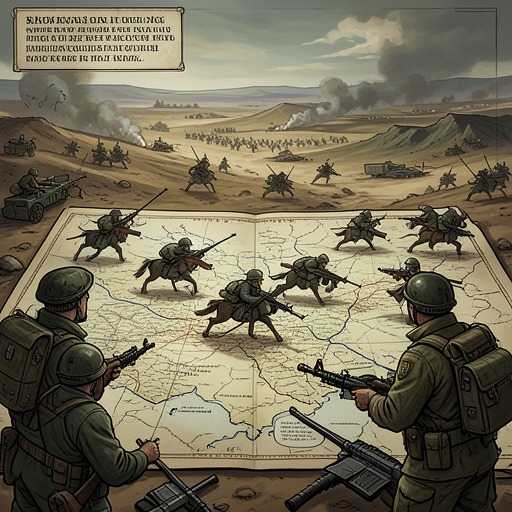
At staff headquarters in Pretoria, and later in Windhoek and Tsumeb, Rysiek describes maps covering the walls and senior officers working over the campaign in detail. The operation was named Orange. Its stated objective was to occupy Luanda by 18:00 on 10 November 1975, when the last Portuguese units were due to leave Angola under the Alvor Agreement. The following day, the planners intended to announce independence with power passing to an FNLA–UNITA coalition government.
That deadline made the departure of the colonial garrison more than a date on a military calendar: it was the opening through which the planners expected to determine who would inherit the capital. The operation’s political purpose is explicit in the account. It was not simply to advance through territory, but to reach Luanda in time for a particular transfer of authority. The later independence scene in the book therefore stands in pointed contrast to the plan’s intended outcome.
Three-front design and forces
The plan divided the advance among three routes converging on Luanda. The southern force was to move along the Tsumeb–Pereira d’Eça–Lubango–Benguela–Novo Redondo–Luanda road. It consisted of motorized South African Army units, supported by Portuguese volunteers, FNLA and UNITA units, and the Chipenda force. This was the operation’s principal South African-led axis, extending north from Tsumeb through the south of Angola toward the capital.
A northern advance was to follow the Maquela do Zombo–Carmona–Caxito–Luanda road. FNLA units formed its main force, with support from units of the Zairean Army and Portuguese volunteers. The eastern advance was to run along the Nova Lisboa–Quibala–Dondo–Luanda road, using the same supporting forces as the northern flank. The coordinated routes were intended to bring pressure toward the capital from several directions at once, rather than rely on a single road and one advancing column.
The planning discussion reveals disagreement over how much time the operation required. One group argued for an earlier start because resistance could delay the advance and the supply lines for ammunition, fuel, and food would grow longer as the forces moved into Angola. Others expected little resistance, reasoning that northern forces were already near Luanda and that the southern advance could proceed quickly in Panhard armoured vehicles. They proposed 27 October as sufficient. The more cautious timetable prevailed: zero hour was fixed for Sunday, 19 October. The planners still characterized a campaign lasting as long as three weeks as a rapid advance.
The war as information and uncertainty
The plan appears in a narrative in which military claims and reports are repeatedly difficult to reconcile with events on the ground. In September, an unmarked black aircraft dropped leaflets asserting that Holden Roberto’s army was outside Luanda and would soon enter the capital. The leaflets urged the population to target Eastern European personnel said to be commanding MPLA units; Rysiek notes that he was the only person from Eastern Europe then in Angola. In a city where no effective authorities existed and PIDE gangs were moving about with impunity, such messaging compounded his personal exposure and the wider atmosphere of insecurity.
The account also shows how official war language could obscure rather than clarify the military situation. Comandante Ju-Ju’s radio communiqués celebrated victories and described the MPLA army in heroic terms. Rysiek observes that the broadcasts became longer and more emphatic when circumstances worsened, while brief, calm reports tended to accompany better news. On one evening, Ju-Ju’s optimistic account seemed particularly at odds with Rysiek’s assessment that half the country was in enemy hands. The contrast matters to Operation Orange because the campaign was conceived amid contested information: proclamations of imminent victory, reports of enemy movements, and the practical uncertainty of whether forces could hold or reach the capital.
Zero hour and approach to Luanda
On 19 October, the date selected as zero hour, Comandante Farrusco set out with his driver along a road through the bush. They encountered an approaching column of armoured vehicles with a helicopter above it, and came under fire. The account does not describe this as a full operational report, but the encounter gives the planned advance a concrete presence: the column was no longer only a line on a map or a timetable discussed at headquarters. Comandante Farrusco’s party turned back toward the rear.
The intended northern threat was also part of daily expectation in Luanda. During the Battle for Caxito, Comandante Ndozi’s unit seized the town from the FNLA, while Comandante Ju-Ju’s broadcasts tracked the changing front. The shifting reports left the outcome uncertain: a short announcement could suggest that the MPLA was holding or had taken ground, while a prolonged communiqué could signal trouble. This local contest helps explain why the planners’ confident assumptions about the enemy’s limited ability to resist could not be treated as an established account of what would happen.
Luanda under pressure and the political outcome
The capital described around the operation was already losing residents and services. Portuguese families arrived from across Angola in cars loaded with people and baggage, first filling hotels and then gathering around the airport, where many waited in the open for flights out. The city’s population was caught between fear of the fighting and the collapse of ordinary arrangements; a crowd of refugees struggled over access to scarce seats, with no accepted rule for deciding who should leave first.
Other signs of institutional withdrawal accumulated. The police had left Luanda, while the departure of the garbagemen became visible only when refuse began to pile up through streets and squares. Water was short because pumping stations lay near the front and repairs were repeatedly undone by fighting. Such details do not establish that Operation Orange caused the city’s broader collapse; they show the conditions in which its planned seizure of the capital was expected to take place, and how little public order remained dependable.
On 4 November, armed men entered the Tivoli Hotel, demanded a list of guests, and brought frightened residents downstairs for questioning. The MPLA press chief, Almeyda, arrived in the morning and ordered them to release the people and leave. The episode illustrates the precariousness of authority inside the city even as the northern front was described as quiet, awaiting the approach of forces from the south for a possible coordinated attack. The operation’s intended convergence depended on movements whose timing remained uncertain, while Luanda itself was vulnerable to rumor, armed intimidation, and a breakdown of routine administration.
The political ending recorded in the book differs from the transfer envisaged at the planning tables. On 11 November, Agostinho Neto read a text proclaiming the People’s Republic in Luanda. The plan had called for an FNLA–UNITA coalition to assume power after the Portuguese departure; the recorded proclamation instead names a different political outcome. By setting the detailed operational scheme beside the crowded airport, the uncertain front, and the independence ceremony, Rysiek presents Operation Orange not as an abstract staff exercise but as a bid to determine the capital’s future whose scheduled deadline did not itself guarantee the result its planners sought.